
If the outputs regarding Real-time event 34 (SIG34) disturb with debugging on Linux using gdb or ddd, one may configure the GDB to ignore these events:
handle SIG34 pass
handle SIG34 noprint
If the outputs regarding Real-time event 34 (SIG34) disturb with debugging on Linux using gdb or ddd, one may configure the GDB to ignore these events:
handle SIG34 pass handle SIG34 noprint
The German article provides more detailed information about it.
In general a CANopen Master device may have up to 127 different SDO clients that can be configured in any way to communicate with various SDO servers spread over multiple devices in the network. To establish an SDO connection between two devices 2 different CAN-IDs are used and they need to be configured at both the SDO clients and inside the SDO servers. Anyway, most SDO devices only come with 1 SDO server using the CAN-IDs according to the Pre-Defined Connection Set. In this case the configuration is only required on the SDO clients’ side. Two different ways of using SDO clients are most common.
In this way the SDO Client (e.g. inside the CANopen Master) only has 1 SDO client and therefore only 1 SDO Client object 0x1280 in the object dictionary:

which contains the following data in the sub indices:
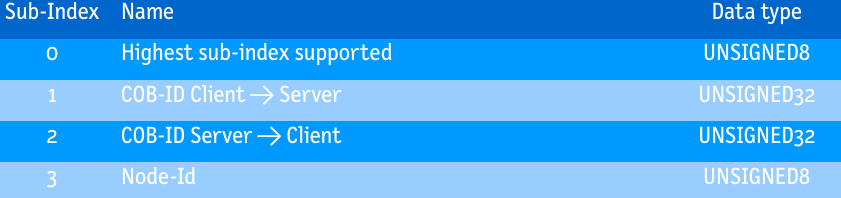
The values of the subindices 1 ..3 have to be reconfigured (internally) each time the SDO client shall be used to communicate with another device. So only 1 SDO transfer at a time is possible from this CANopen Master.
The other approach is using a dedicated SDO Client for each SDO server (in a CANopen slave). The most useful approach would be to assign the 1st SDO client to node 1, the 2nd SDO client to node 2 and the 127th SDO client to node 127.
For this way the object dictionary of the CANopen Master device requires 127 SDO client objects.

According to the predefined connection set all these SDO clients are disabled at start-up and needs to be configured e.g. by the application at startup accordingly. So the 1st SDO clients would use the CAN-IDs 0x601 and 0x581 to communicate with node 1 and the 100th SDO client (configured at object 0x12e3) would use the CAN-IDs 0x6e4 and 0x5e4 to communicate with node 100. Using this approach up to 127 SDO transfers in parallel are possible.
If the network consists only of a few slave nodes for example 10, 32 and 64 it is also possible to implement only the 10th, 32th and 64th SDO client in the CANopen master devices.
Some implementation hints for EnergyBus in light-electric vehicles such as e-bikes:
It is recommended to have some non-volatile memory (EEPROM, EEPROM emulation, …) on the EBC hardware to store identity information of the connection components. This will increase the start-up of the network inside the vehicle significantly.
An EnergyBus service tool according to the CiA 454 specification reports itself by sending heartbeat of the node-ID 125. The EBC should recognize this and should e.g. prevent the Motor Controller (MCU) from powering. The bike shouldn’t move when a service tool is connected or do SDO transfers.
The EnergyBus specification CiA 454 requires the use of dynamic node-IDs assigned by the EBC at startup. Using fixed node-IDs might work in the beginning with some other devices, but it will cause compatibility problems in the long term.
Using a dynamic instance offset (write-able object 0x6000:xx), the EBC can assign a different global instance number to the device and thus multiple devices of the same type, will be supported. It always only starts with 1 battery or 1 HMI, but mostly there will be more in the future.
According to the EnergyBus specification the usage of a boot-loader to update the firmware in the field is recommended. In addition to that it is recommended to implement some checks in the bootloader that it does not start a wrong application but with valid CRC, that has been flashed by accident.